When Growth Outpaces Your People Infrastructure: Why HR, Communication and Culture Must Evolve Together
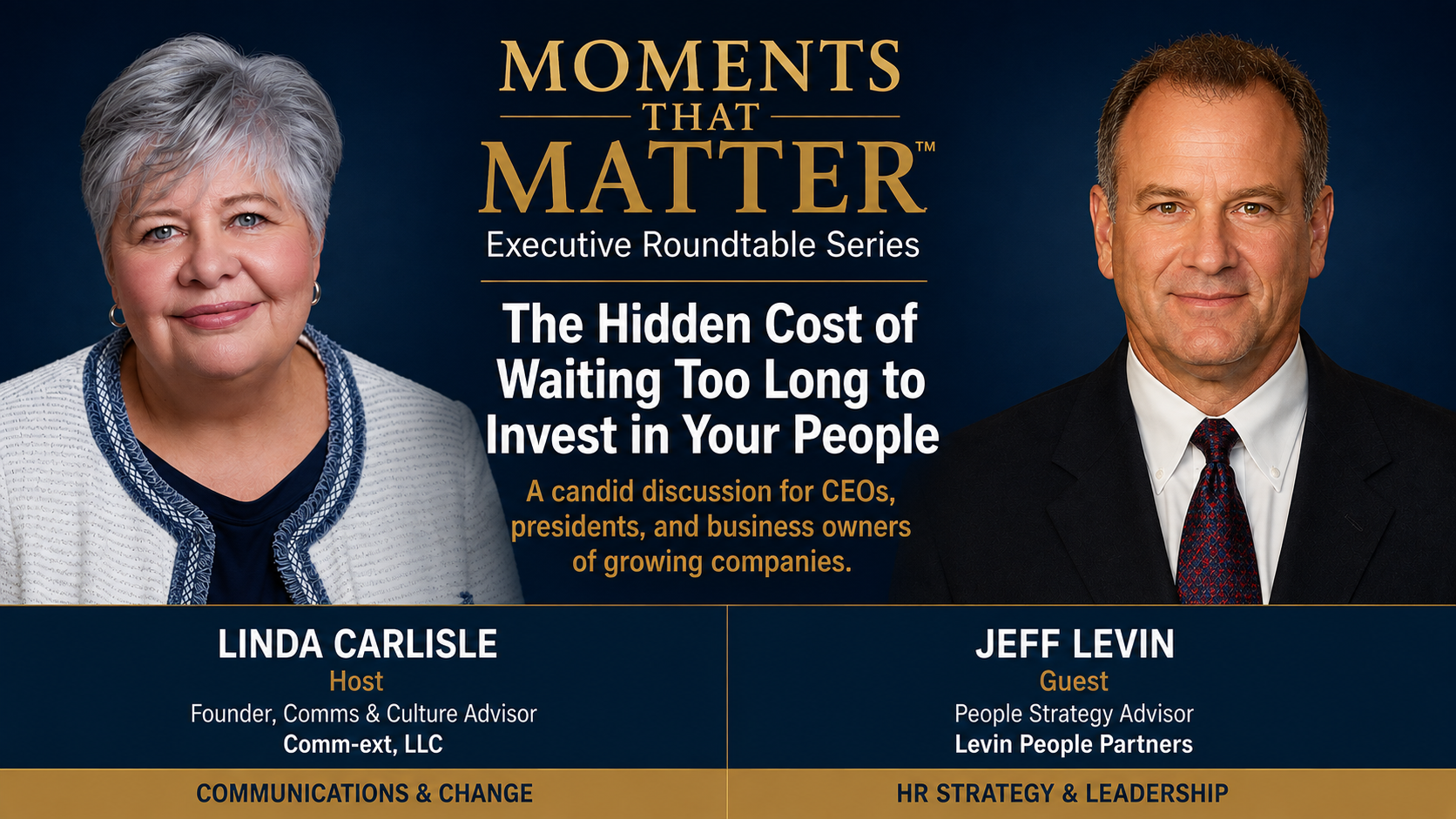
Moments That Matter: Executive Roundtable
Episode 1: Featuring Jeff Levin, Levin HR Consulting
Growth is supposed to be a good thing.
Revenue increases. New customers come aboard. Headcount expands. The organization takes on new opportunities, new markets and greater complexity.
But something doesn't always grow at the same pace: the infrastructure needed to help people succeed.
The leadership practices that worked when everyone knew each other no longer scale. Managers develop different approaches to handling performance issues. New employees have inconsistent onboarding experiences. Communication becomes fragmented. And the CEO, who once had a direct line of sight into nearly everything, begins hearing about problems only after they've become serious.
Before long, the symptoms become difficult to ignore: regrettable turnover, disengagement, confusion, inconsistent execution and declining trust.
The company has grown, but the systems that connect its people to its strategy haven't kept up.
That's the challenge at the heart of the first episode of Moments That Matter: Executive Roundtable, a new conversation series exploring the critical inflection points that shape organizational performance.
My guest, Jeff Levine of Levin HR Consulting, and I approach these challenges from complementary perspectives. Jeff focuses on HR strategy, leadership capability and the people processes organizations need to support growth. My work focuses on strategic communication, organizational culture and helping people understand, navigate and execute consequential change.
Our conversation reinforced something we both see in our work: what looks like an HR problem often has a communication dimension, and what looks like a communication problem may have deeper organizational causes.
The Warning Signs Are Often Symptoms, Not the Problem
Imagine a 120-person manufacturing company whose revenue has doubled over four years.
On paper, the business is thriving. But employees are leaving, managers are handling performance issues inconsistently, and people complain that leadership isn't communicating.
Where should the CEO start?
Jeff's answer is revealing: the problems on that list are real, but they may be symptoms of something more fundamental.
Rather than immediately introducing another retention initiative, training program or employee communication campaign, he begins by diagnosing the organization.
Are problems concentrated in a particular plant, function or team? Are managers equipped to lead difficult conversations? Do employees understand expectations? Are the people processes that worked for a smaller company still appropriate for the business today?
Employee surveys, focus groups and conversations with leaders can reveal patterns that aren't visible when each issue is treated independently.
This is where experience matters.
Solving the wrong problem can be expensive, even when the solution itself is well executed.
When the Structure Breaks Down, Trust Often Follows
I tend to encounter a related challenge during periods of significant organizational change.
A company introduces a new strategy, appoints a new CEO, reorganizes teams or establishes more demanding performance expectations.
Leadership has spent months evaluating the situation and determining the right course of action. The decisions may be entirely appropriate.
But employees haven't participated in that process.
They see priorities changing, familiar projects disappearing, reporting relationships shifting and expectations increasing. They may understand what is happening without understanding why.
In the absence of that explanation, people begin constructing their own.
Is the company in trouble? Is my job secure? Does leadership know what it's doing? Can I trust the new direction?
I've seen this dynamic in a private-equity-backed organization where a new CEO was under considerable pressure to deliver growth. The leader introduced changes intended to improve performance, but the rationale wasn't communicated with sufficient clarity throughout the organization.
Employees felt the urgency without understanding the opportunity.
Instead of building momentum, the changes generated uncertainty and fear—and productivity suffered.
The problem wasn't necessarily the strategy. It was the gap between leadership's understanding of the strategy and employees' ability to make sense of it.
A sound business decision can still produce a poor business outcome if the people expected to execute it don't understand or trust the direction.
One Announcement Isn't a Change Strategy
This is one of the most common misconceptions I encounter.
Leaders have spent weeks or months studying a problem, evaluating options, debating trade-offs and arriving at a decision. Then they announce the decision and expect the organization to move forward.
But employees are hearing the conclusion without the benefit of the journey that led to it.
Getting people to understand and support change requires more than telling them what has been decided.
It means explaining why the change is necessary, what it means for the business, what it means for individual functions and what people will need to do differently.
It also means equipping managers to translate enterprise priorities into the realities of their teams.
And it means listening.
Did employees understand the message? What concerns emerged? Where is the strategy being interpreted differently? What additional information or support would help people move forward?
Communication during change is not a single event. It's an ongoing process of building understanding, alignment, confidence and capability.
HR and Communication Solve Different Parts of the Same Challenge
One of the most interesting themes in my conversation with Jeff was how often our respective disciplines intersect.
HR strategy can establish clearer expectations, stronger management practices, better onboarding, more effective performance systems and the organizational structure needed to support growth.
Strategic communication helps people understand those expectations, trust the direction, navigate transitions and translate business priorities into action.
Neither discipline replaces the other.
A beautifully communicated strategy won't fix broken management processes. And well-designed processes won't deliver their full value if employees don't understand what is changing or why.
This becomes particularly important during mergers and acquisitions, leadership transitions, rapid growth and organizational transformation.
In an acquisition, for example, the financial and operational logic may be compelling. But the ability to realize that value depends on people: the leaders who remain, the employees who carry institutional knowledge, the teams that must work together and the culture that emerges from the integration.
The organization needs both a people strategy and a deliberate approach to communication and change.
What Got You Here Won't Necessarily Get You Where You Want to Go
Near the end of our conversation, Jeff shared something a business executive once said to him:
“What got me here is not gonna get me to the next level.”
That observation captures the challenge of organizational growth.
The practices that helped a company succeed at one stage may become constraints at the next.
A founder's personal relationships may no longer be sufficient to keep employees aligned. Informal management practices may create inconsistency. Communication that once happened organically may now require deliberate systems, processes and leadership attention.
Recognizing that shift is not an admission of failure. It's a sign that the business has reached another stage of maturity.
And it doesn't always require building a large permanent executive team. Experienced fractional HR, communications and change leaders can help organizations diagnose problems, build the necessary capabilities and navigate critical transitions without immediately committing to additional full-time executive roles.
The key is recognizing the moment before the consequences become too costly.
Watch the Conversation
In this first episode of Moments That Matter: Executive Roundtable, Jeff and I explore:
- Why growing companies outgrow their people infrastructure
- How to distinguish organizational symptoms from underlying problems
- Why communication breakdowns can erode trust and performance
- What HR and communication leaders each contribute during M&A and other major changes
- Why listening is one of the most overlooked leadership capabilities
- When experienced fractional expertise becomes mission-critical
# # #
About Our Guest: Jeff Levine
Jeff Levine of Levin HR Consulting works with growing companies to strengthen HR strategy, leadership practices and the people processes needed to support sustainable performance. His approach emphasizes diagnosing underlying organizational challenges and developing practical solutions that help businesses scale.
Connect with Jeff: https://www.linkedin.com/in/jeffslevin/
About Linda Carlisle and Comm-ext
Linda Carlisle is the founder of Comm-ext, providing fractional strategic communications, culture and change leadership to organizations navigating the Moments That Matter™—including growth, mergers and acquisitions, leadership transitions, reorganizations and enterprise transformation.
Comm-ext helps organizations connect business strategy with the communication, alignment and workforce readiness needed to execute it.
Learn more: https://www.comm-ext.com/fractional-communications-change-culture