Flying the Plane While Building It?
Why It May Be Time for a Better Metaphor for Organizational Transformation

Over the years, I've heard countless leaders describe organizational transformation as "flying the plane while building it."
It has become one of the most recognizable metaphors in business. Whether an organization is integrating an acquisition, implementing new technology, navigating a leadership transition, restructuring operations, or pursuing an ambitious growth strategy, the phrase inevitably surfaces. It captures an undeniable reality: organizations rarely have the luxury of stopping while they evolve. Customers still expect excellent service. Products still need to ship. Quarterly targets don't pause simply because a transformation is underway.
For a long time, I accepted the metaphor without giving it much thought.
Today, I'm no longer convinced it's serving leaders -- or their organizations -- as well as we think.
Not because it's inaccurate. In many respects, it reflects the operational complexity of leading change.
But because metaphors do more than describe reality...they shape it.
The language leaders choose influences how employees interpret uncertainty, competence, risk, and ultimately, trust. Over time, I've come to believe that the phrase "flying the plane while building it" unintentionally normalizes a leadership mindset that is inconsistent with successful transformation.
Imagine hearing that phrase not as an executive discussing strategy, but as an employee trying to make sense of another major organizational change. Or better yet, imagine hearing it as a passenger boarding a commercial flight!
The image is unsettling because it suggests an unfinished aircraft, unnecessary risk, and a crew making critical decisions after takeoff rather than before it. Even when leaders use the metaphor casually, employees may hear something entirely different:
"We're making this up as we go."
That isn't the message most leaders intend to send. Unfortunately, intention and interpretation are rarely the same thing.
Leadership's Challenge Isn't Navigating Change. It's Building Confidence.
One of the greatest misconceptions about transformation is that organizations fail because people resist change.
In my experience, resistance is rarely the root cause.
People are remarkably adaptable. They learn new technologies, adopt new processes, embrace new leaders, and navigate mergers, restructures, and strategic pivots every day. Most employees understand that change is part of organizational life. What they struggle with is uncertainty and risk that appears avoidable.
When leaders communicate conflicting priorities, managers lack the information they need to answer basic questions, or decisions seem to change without explanation, employees begin to wonder whether anyone is truly steering the organization with confidence. It isn't the presence of change that erodes trust. It's the perception that the organization is creating uncertainty it could have prevented.
Successful transformation has never been about eliminating uncertainty altogether. Markets shift.
Competitors respond. Technology evolves. Unexpected obstacles emerge. Those realities are part of doing business.
The responsibility of leadership isn't to eliminate these uncertainties entirely. It is to eliminate the unnecessary uncertainties.
Great leaders don't ask employees to tolerate unnecessary uncertainty....They reduce it.
They reduce it through thoughtful preparation, consistent communication, visible leadership, disciplined execution, and a willingness to address confusion before it becomes frustration. They help people understand not only what is changing, but why it matters, what success looks like, and the role each individual plays in creating that future.
That distinction changes everything.
Five Warning Lights Leaders Should Never Ignore
Confidence rarely disappears overnight.
Instead, it erodes gradually through a series of warning lights that leaders often overlook while focusing on project plans, budgets, governance, and implementation milestones.
The first warning light is leadership misalignment. Employees can tolerate uncertainty; what they struggle to tolerate is inconsistency. When leaders communicate different priorities, offer conflicting interpretations, or answer similar questions in different ways, employees begin questioning whether leadership is truly united.
The second warning light is cumulative change. Organizations divide transformation into work streams because that's how projects are managed. Employees experience something entirely different. Every initiative competes for the same managerial attention, subject matter expertise, and employee capacity. Individually, each request appears reasonable. Collectively, they become exhausting.
The third warning light appears when communication becomes one-directional. Most organizations invest heavily in explaining change. Far fewer invest the same discipline in listening. Without meaningful feedback loops, leaders lose visibility into confusion, resistance, misinformation, and emerging risks long before they appear on a dashboard.
The fourth warning light is mistaking project readiness for workforce readiness. Technology can be tested. Budgets can be approved. Governance can be established. None of those milestones guarantee that managers are prepared to lead or that employees understand what is expected of them.
The fifth warning light is declining trust. During periods of transformation, trust becomes one of the organization's most valuable assets. Once employees begin questioning leadership's competence, consistency, or credibility, every subsequent initiative becomes more difficult than the last.
These warning lights rarely appear in isolation...they compound.
Misalignment creates confusion, confusion increases anxiety, anxiety erodes trust, and diminished trust slows adoption. What leaders often interpret as resistance is frequently the cumulative effect of uncertainty that has been allowed to build over time.
Reducing Unnecessary Uncertainty
If reducing unnecessary uncertainty is one of leadership's most important responsibilities, then transformation requires far more than effective project management.
It requires leadership disciplines that intentionally build confidence.
Those disciplines begin with aligning leaders before communicating broadly so employees hear one coherent message rather than several competing interpretations. They continue with explaining the purpose behind change instead of focusing exclusively on timelines, helping people understand why the journey matters as much as where it leads.
They require leaders to think beyond individual initiatives and consider the cumulative experience of employees, recognizing that people rarely experience transformation one project at a time. They require investing in managers before expecting them to lead others, because managers remain the organization's most influential communicators during periods of uncertainty.
They also require listening with the same discipline used to communicate. Pulse surveys, focus groups, skip-level conversations, and manager feedback aren't simply engagement activities; they're early-warning systems that surface confusion while leaders still have time to respond.
Finally, they require measuring workforce readiness alongside project readiness. Organizations do not transform because a project plan reaches completion. They transform because people choose to adopt new ways of working. Technology, process, and governance make change possible. People make it successful.
Taken together, these leadership disciplines reduce unnecessary uncertainty while creating the conditions that allow organizational resilience to grow.
A Better Metaphor
If metaphors influence leadership thinking, then perhaps it's time to choose one that reinforces the behaviors successful transformation actually requires.
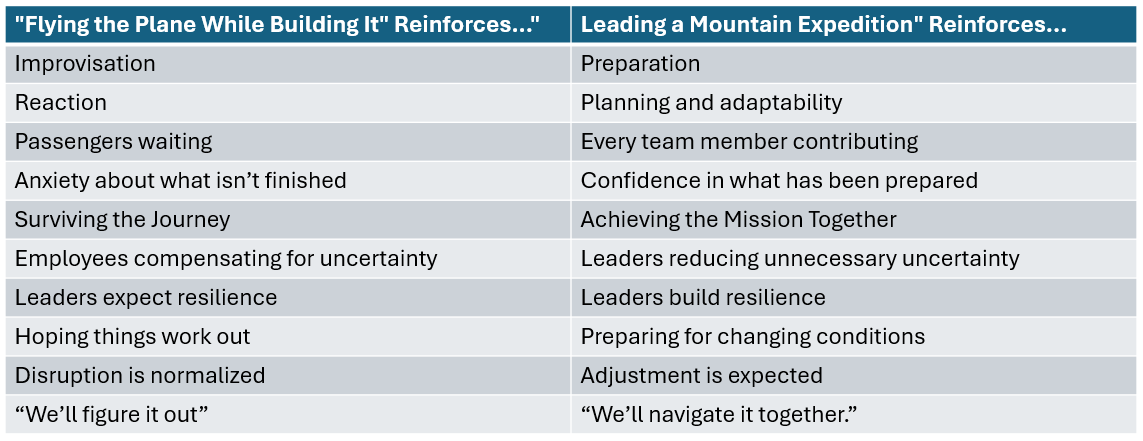
Rather than asking employees to imagine boarding an unfinished airplane, I'd invite leaders to picture a mountain expedition.
Every successful expedition begins long before the first step is taken. The destination is clear. The route has been studied. Equipment has been tested. The team has trained together. Experienced guides understand both the terrain ahead and the capabilities of the people making the journey.
Then reality intervenes.
...Weather changes.
...Conditions deteriorate.
...Progress slows.
...Some climbers require more time to acclimate.
...The route may need to adjust.
These realities don't suggest poor leadership, but they do represent predictable uncertainties that leaders should prepare their team to face.
Great expedition leaders don't pretend they can eliminate uncertainty. They prepare people to navigate it. They communicate constantly, monitor conditions, adjust the pace when necessary, and make decisions that keep the team moving toward the summit without losing sight of the people making the climb.
The difference between these two metaphors is more than literary. They reinforce two fundamentally different philosophies of leadership.
The role of leadership during transformation isn't to promise a smooth journey.
...Markets will shift.
...Technology will evolve.
...Unexpected obstacles will emerge.
The future has always contained uncertainty, and it always will.
The responsibility of leadership is something different.
It is to reduce the uncertainty that can be reduced, prepare people for the uncertainty that cannot, and create the conditions that allow individuals and teams to succeed despite it.
For that reason, I believe it's time to retire the phrase "flying the plane while building it."
Not because transformation has become easier. But because the metaphor normalizes a leadership mindset that is inconsistent with successful transformation.
The mountain expedition offers a better model. It reminds us that great leaders prepare thoroughly, communicate honestly, adapt thoughtfully, paint a picture of what success looks like, support one another, and continue moving toward the summit together. Most importantly, it reinforces the kind of leadership organizations need when the path ahead is demanding but the destination remains worth pursuing.
The metaphors leaders choose should reinforce the behaviors they expect across the organization -- starting with themselves.