From childhood awareness to climate reality... why this moment demands more from all of us
The First Realization
My first real awareness of humanity’s carelessness toward the planet came when I was about seven or eight years old.
Sitting at a restaurant called Golden Bear with my father, I learned that the California grizzly bear -- once a symbol of strength and still emblazoned on the California state flag -- had been hunted to extinction in the state after its habitat was steadily destroyed.
Even as a child, that felt…wrong.
When Carelessness Was Normal
I also remember learning about pollution -- and how casually people treated it.
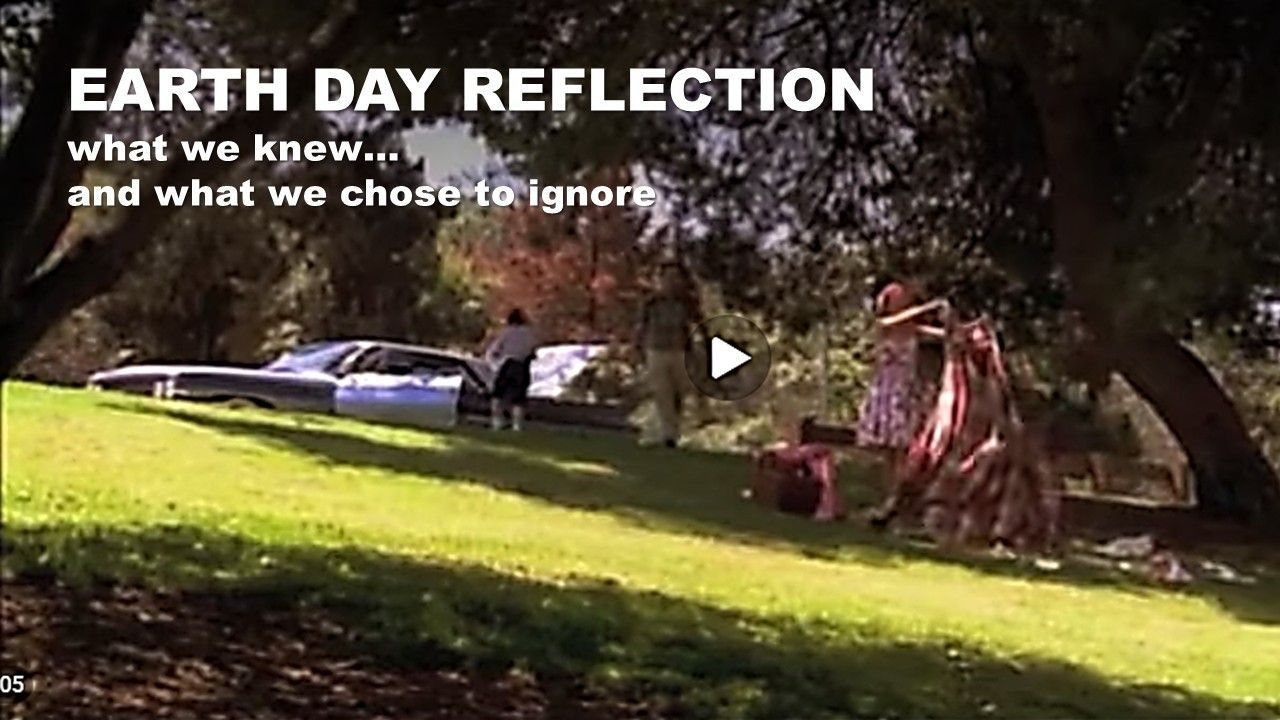
There’s an iconic scene from Mad Men where Don Draper's family finishes a picnic and simply shakes their trash out onto the ground before driving away.
It’s jarring to watch today.
But it wasn’t fiction. It was normal.
People would never litter their own homes that way. Yet the natural world -- our shared home -- was treated as disposable.
What We Couldn’t See Was Worse
Litter was just what we could see on the surface.
Far more dangerous damage was happening out of sight:
- The Love Canal disaster exposed families to toxic chemical waste buried beneath their homes
- The case made famous by Erin Brockovich revealed groundwater contamination on a massive scale
- Entire communities -- often marginalized -- were disproportionately impacted, giving rise to what we now call environmental racism
At the same time, we were confronting global threats:
- Ozone layer depletion caused by CFCs
- Acid rain driven by industrial emissions
And in those moments, something important happened:
We acted.
International agreements like the Montreal Protocol proved that when SCIENCE, POLICY, and the PUBLIC WILL for something better align, meaningful change is possible.
From Awareness to Action
As a young adult, I joined the Sierra Club.
I learned. I advocated. I believed -- like many still do -- that informed citizens could influence the direction of our future.
Because this is the only home we have. And many actions, once taken, cannot be undone.
Today’s Reality: A More Dangerous Chapter
Today, the stakes are higher.
Climate change is no longer theoretical -- it is visible, measurable, and accelerating.
From melting Arctic ice affecting polar bears to unstable Antarctic conditions impacting penguin populations, and virulent storms sweeping the landscape in between, the effects are being felt across the planet.
In recent years, large numbers of penguin chicks have died when sea ice broke apart too early -- before they developed waterproof feathers -- leaving them vulnerable to freezing and drowning.
These are not isolated incidents.
They are signals.
The Return of Doubt
And yet -- despite overwhelming scientific consensus -- we are seeing something disturbingly familiar.
A resurgence of DELIBERATELY ORGANIZED DOUBT.
The same playbook once used by the tobacco industry -- creating confusion, delaying action, undermining trust -- has resurfaced in the climate conversation.
It’s a strategy that was even reflected in Mad Men.
And it’s working.
It's providing confusion and cover while powerful economic forces continue to prioritize short-term gain over long-term sustainability:
- Continued reliance on fossil fuels
- Rapid expansion of energy-intensive technologies like AI infrastructure
- Erosion of institutions designed to protect environmental standards
When It Feels Helpless
It’s enough to make anyone feel powerless.
But history -- and humanity -- tell a different story.
As Margaret Mead said:
“Never doubt that a small group of thoughtful, committed citizens can change the world; indeed, it’s the only thing that ever has.”
An Earth Day Invitation
So today, I’m asking you to do something simple.
Step outside. Look up at the sky. Breathe deeply.
Touch the petals of a flower. Sit quietly in the grass for a few minutes.
Reconnect with the extraordinary, fragile system that sustains us all.
What Happens Next Is Up to Us
And then -- when you return to your day -- pay attention.
When you hear about environmental issues:
- Look beyond the headlines
- Question the spin
- Stay curious
- Stay informed
Reach out to your representatives -- even if it feels like your voice is just one among millions.
Because it is.
And that’s exactly the point.
Final Thought
Together -- collectively, persistently -- we still have the ability to change direction.
To protect what remains.
To restore what we can.
To leave behind not just warnings…but a world still worth inheriting.
A Note to My Business Readers
You may be wondering why I chose such a personal -- and potentially provocative -- topic for this newsletter.
Because culture doesn’t stop at the walls of an organization.
Companies that lead with social purpose and a genuine sense of community don’t just build stronger cultures -- they earn trust, loyalty, and engagement from the very people they depend on most.
And this matters even more when you consider the future of the workforce.
By 2035, Generation Z will make up a significant share of employees -- and they are already deeply aware of the environmental challenges we face. They expect honesty. They expect action. And they are unlikely to stay silent in the face of denial or inaction.
This creates a clear opportunity for business leaders:
To step forward as credible voices. To align values with action. To lead in ways that resonate beyond the balance sheet.
In many organizations, that begins by embedding PURPOSE more visibly into the employee experience -- through thoughtful approaches to ESG, CSR, and community engagement that feel authentic, not performative.
When done well with input from your people, these efforts don’t just support the outside world -- they strengthen the inside of the organization, creating connection, meaning, and a shared sense of responsibility.
And believe me -- the organizations that get this right will be the ones that attract -- not just top talent -- but loyalty and belief.
As a communications and culture advisor, I help organizations design community engagement and ESG programs that reflect their brand and genuinely inspire their people - happy to connect if this sparks your curiosity.
~Linda