Weave strategy and culture pearls into your day-to-day messages for a more powerful and holistic employee experience.
Don't fill your channels with tactical messaging lacking relevant tie-ins to strategy & culture.

This past weekend, I watched a show that was a little out of character for me, featuring seasoned former generals and Pentagon strategists discussing how to win a war.
They pointed out the different layers of planning that need to take place to be the victors – chiefly tactical, operational, and strategic analysis and planning.
For example, say you want to gain mastery of a particular geographic region to gain unfettered access to crude oil. That type of planning is strategic because it outlines your big picture objectives and why they are important.
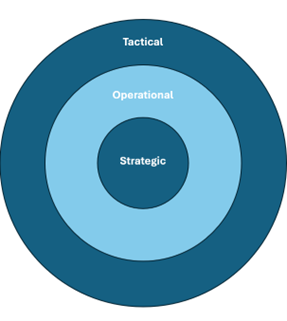
Successful planning should combine strategic considerations with operational and tactical activities.
To achieve this, you might decide to bombard a particular nation’s military installations with a magnitude of Tomahawk missiles, drawing down your supply. Bombing is tactical.
Now, let’s say that you need your Tomahawk missile supplies to remain at a steady inventory level to protect your allies and homeland security, and you had previously planned on building just two of these costly items in 2026. Now that you are accelerating the use of these vital munitions, you have decided to increase planned production from 2 to 1,000 in 2026. This requires budget (which you have already requisitioned from Congress), and rare earth minerals that are only available from China.
Unfortunately, you have been pursuing a tactic of systematically increasing tariffs on China for the last 14 months – but you have also given them access to highly sensitive computer chips needed for AI dominance – so hopefully you come out ahead and will still be able to obtain the rare minerals you need for your new Tomahawk order. These overlapping considerations are operational in nature.
Ideally, a business (or nation) analyzes and plans these goals and objectives in a specific order, taking into consideration first the Strategic, then aligning the Operational, before executing the Tactical in order to keep all efforts aligned and supporting your long-term highest order objectives – because executing too many tactical activities without supporting a big picture strategy can be costly and inefficient.
As I played around with what I had heard, I found this framework very useful for thinking through the business case for engaging a communications professional to drive internal communications strategy – even for small- and mid-sized businesses.
In fact, especially for small to mid-sized businesses. Here’s why.
Smaller businesses are often resource-constrained – unlike larger corporations, they cannot afford to be cavalier and wasteful in their communications efforts. One could argue that every communication should have maximum impact in smaller organizations that are still growing. Yet, these firms rarely have a communications professional on staff – when they do, they are usually almost exclusively focused on external marketing efforts. This leaves internal communications largely up to HR…and HR is already plenty busy doing HR things. Nor have they been trained as strategic communicators. As a result, internal communications tend to become tactical in nature.
However, in focusing exclusively on tactical communications (“we can’t afford a communications professional, so we’ll just make do with an HR generalist sending out all the messages deemed necessary”), the opportunity to simultaneously drop strategic and well-timed operational payloads with each tactical message is lost.
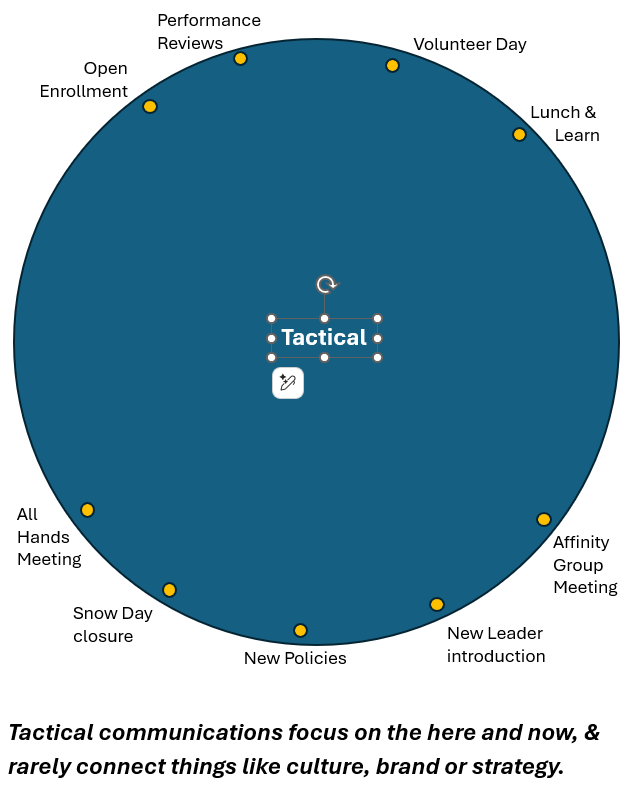
When the only messaging employees regularly receive is tactical, they are informed but rarely engaged, inspired, or aligned. They do not achieve the level of understanding needed to be fully empowered and to develop their own insights into how their work aligns with higher-order objectives.
But wait, you say, we do have all-hands town hall meetings where leaders share strategic objectives, and functional leaders do share operational goals with their teams.
But these one-time, top-down messages rarely help people connect the dots between the company’s top-level strategies, the desired culture, and the activities they see take place each day on the front line.
And consider that research indicates, on average, that people need to hear or see a message roughly seven times before it truly sinks in and drives action, a principle often known as the "rule of 7". This repetition builds familiarity, trust, and credibility, helping messages rise above noise and overcome short-term memory limitations. Companies that lack a communications strategy and a person to ensure it is achieved will never reach this 7X number and will never begin connecting the tactics they see here and now to the actual strategies in play.
Messaging at the tactical level, as when busy HR pros send out messages to drive attendance and adoption of specific events and programs as they arise, does little to help employees see the big picture and connect the dots in ways that drive higher-level performance.
Today HR announced a new benefit.
Tomorrow there is a community volunteer event.
Next week, a new strategy for a key product line prompts a broad reorganization of the sales, marketing, and operations teams. Two leaders are let go, and their teams are being reorganized to report to new leaders. Projects are being re-prioritized.
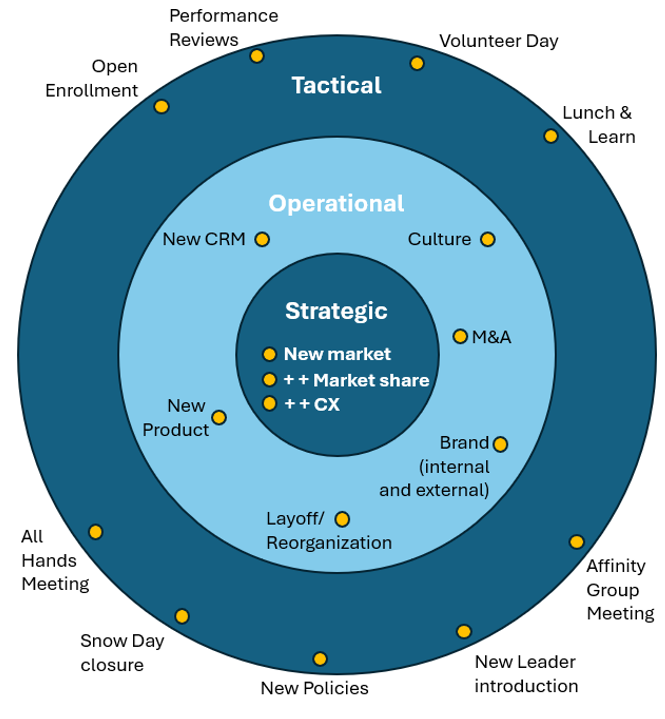
Effective communication should speak directly to the news at hand, but should also take advantage of the moment to link the message to the higher-level operational and Strategic objectives that are relevant.
The details surrounding the reorganization itself are the only things that get shared in the initial communications – nothing about the new marketing strategy it supports, and people feel the disruptive change like an earthquake shaking their sense of stability (when, in fact, the change has the potential to lead to greater company-wide success and new opportunities for the entire team).
Too many firms operate without a broader communications strategy that elevates messaging and ties tactical and operational efforts together to support the company’s broader strategic agenda in employees’ minds.
Mind you, short-sighted messaging is still effective at achieving the tactical objectives of benefits adoption, volunteer day attendance, and reporting to a new leader. But this approach leaves so much strategic meat off the table – and this keeps your employees feeling uninformed, somewhat disenfranchised, and hungry to understand what is really going on.
Let’s look at how a communications strategy adds breadth and depth to how we might communicate everyday occurrences, like reorganizations. For example, the messaging could reference the company’s plan to enter a new market in the context of their commitment to promoting from within and providing professional development opportunities for employees when the company experiences growth (thus maintaining psychological safety during an event that might otherwise seem scary) and weave in one of the company's values or cultural norms around collaboration, empowerment and enabling innovation, which the new organizational design will enable.
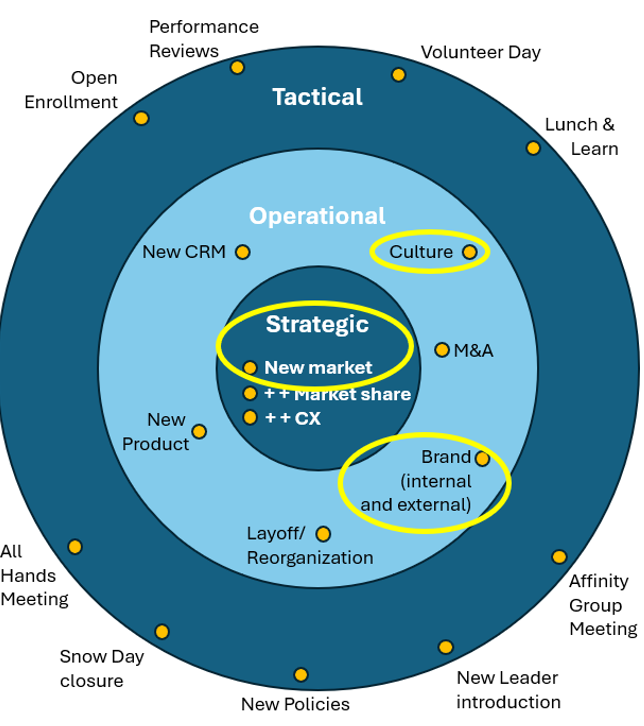
It is important to note that you should only weave in higher-order messages that align with and support the tactical message at hand.
Communication about the reorganization can also connect the dots between a new market strategy your leaders announced way back at the beginning of the year, so people begin to see it as real and tangible rather than just lofty words on paper.
Introducing the Message Map
One way to weave these higher-order communication themes into our straightforward reorg announcement is to build a message map.
Message Maps lay out messages like stepping stones, allowing the communicator to move from one strategic and operational theme to another, connecting the dots and driving greater alignment among seemingly unrelated goals, objectives, and tactics.
Communicated on their own, tactical announcements may seem capricious.
Enhanced message maps enable a communications professional to tie internal and external brand elements, cultural behaviors, and the marketing strategy at the heart of the reorganization into the org announcement, generating alignment, commitment, excitement, and greater psychological safety for employees across the company.
By reminding employees of the company’s strategy to enter a new market, you enable them to better understand that the new org design brings sales, marketing, and operations closer together to collaborate more effectively, share information, and drive the innovations needed to address the needs of this new market. Operations can redesign the manufacturing process to meet the new design specifications that marketing has built into the product at the request of the sales team, who are closest to the new customers.
The newly enhanced messaging also reinforces the desired cultural behaviors that are necessary to successfully navigate the change and meet the needs of the new customers: care, innovation, trust, and collaboration.
Strategic Communications helps you move from
Random Acts of Messaging to deliberately building Culture, Brand, and Engagement
By adding internal brand messaging, such as additional career opportunities and transparency, as well as external brand features, such as the company’s commitment to innovation and offering superior customer experience, a simple organizational announcement connects the dots across several aspects of the company’s identity.
With repetition, achieving 7X or more exposure to key strategic themes, these elements become central to employees’ core beliefs about the company and begin to form a meaningful employee value proposition as team members are repeatedly exposed to these themes over time.
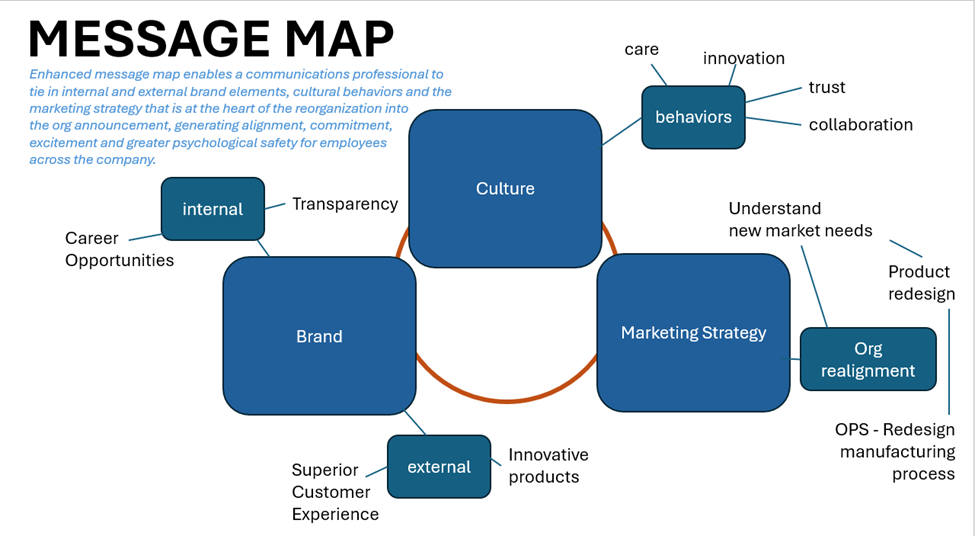
With more frequent exposure to strategic themes, employees internalize these messages, developing a sense of belonging, pride, and a deeper belief in the company’s purpose, culture, and brand. As they come to relate more closely to these messages and align their understanding of their own work with the company-wide strategic themes, team members feel valued, as they engage more deeply with their colleagues and their work, understanding the role each plays in achieving company objectives.

Like an oyster building a pearl, by regularly depositing a deliberate layer of higher-order strategic messaging into organizational consciousness, strategic communications serve as a force multiplier, accelerating performance, building cultural integrity, and enabling strategic alignment. Leaders who see communications only as a cost center do so at their own risk.
Weaving a more strategic framework through your employee messaging enables each communication effort to work harder on your behalf, reinforcing themes that deliberately build a high-performance culture, shaping your employee value proposition and employment brand, aligning the organization around strategy, and driving up engagement, performance, and strategic execution.
If you’re navigating a major transition or growth phase, strategic communication can make a measurable difference in how your team navigates the change. I’d love to explore what’s on your horizon and discuss some techniques for keeping your people informed and engaged!