The Rise of Rizz | What CEO Transitions Teach Us about Executive Communications
From charisma to credibility: navigating leadership transitions in an era of podcasts, social media, and heightened employee expectations.
Early in my career, I watched an organization replace a beloved charismatic leader with someone who was almost the exact opposite.
The outgoing executive was spontaneous, approachable, and magnetic, leading to employees feeling like they knew him. Although the incoming leader was smart, articulate, disciplined, and thoughtful, she was also somewhat reserved, structured and purposeful when she spoke, and far less comfortable in front of large audiences.
The challenge I faced as a communications advisor supporting her wasn't one of enhancing her perceived competence. It was how she came out in a head-to-head comparison with her predecessor. Every interaction was measured against the authenticity and likability of the previous leader, and the questions in the minds of stakeholders were people-related, not strategy-oriented: “Do I like where she seems to be taking the company? Do I believe in her vision? Do I still like working here?”
That's when I learned an important lesson: the success or failure of a leadership transition often comes down to one thing…trust.
Introducing The Rise of "Rizz"
Consider these Gen Z terms that describe this trust paradox:
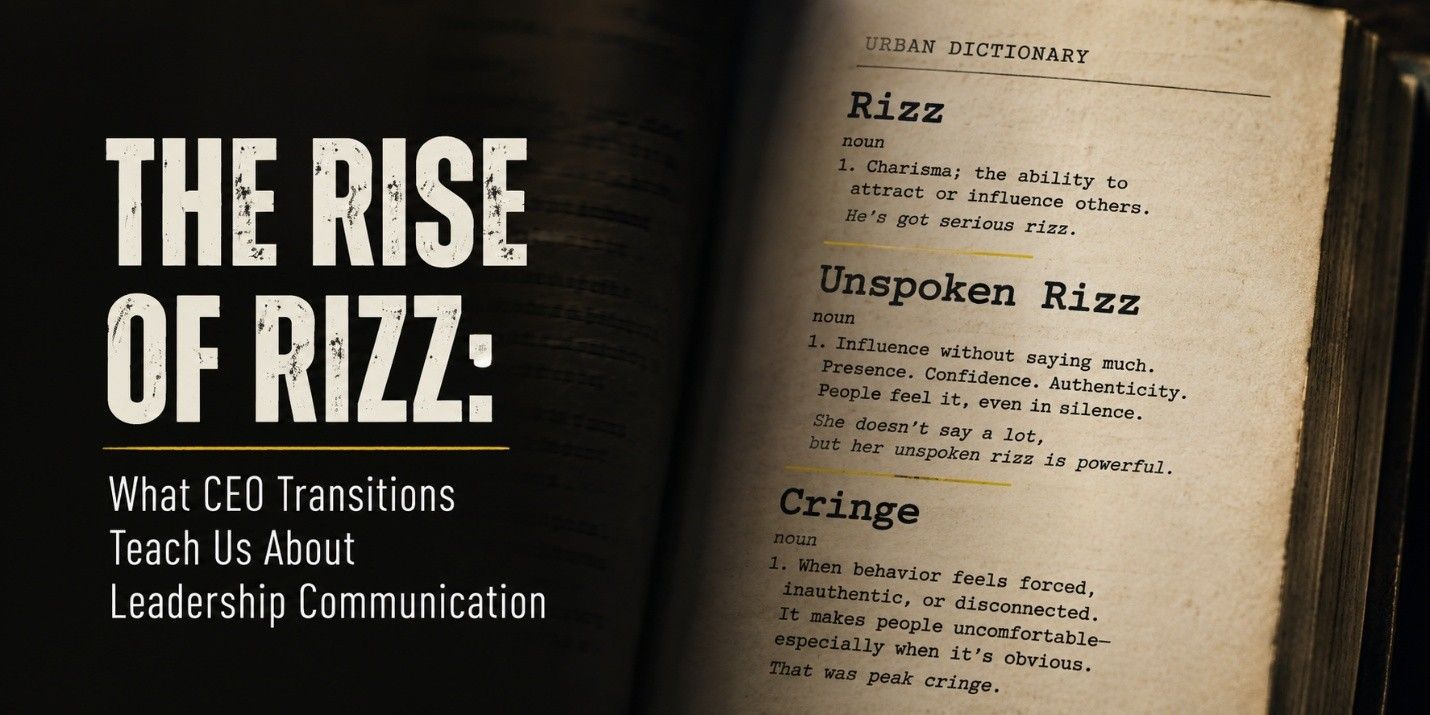
Traditional Rizz --
natural charisma; the ability to attract or influence people. Think the outgoing founder, the magnetic storyteller, the larger-than-life personality.
Unspoken Rizz --
influence without saying much. Presence. Credibility. Authenticity.
Cringe -- behavior that feels forced, inauthentic, or disconnected.
While the terminology may be new, the underlying principle isn't. People have always responded to leaders who feel authentic.
Media trainer Brad Phillips, author of The Media Training Bible, argues that the most effective spokespeople are not the most polished, but they're almost always the most authentic:
"The best media spokespeople are the ones the public perceives as being the same person on camera as off, the same in a television studio as in their living room..."
He advises clients to "start with you and go from there," building on existing strengths rather than forcing people into an artificial communication style.
In other words, the goal isn't to manufacture charisma -- it's to help leaders communicate as the best version of themselves. Employees may not actually need "rizz”, but they do need confidence in leadership, which is built through sharing information about the direction the company is heading with honesty, transparency, inclusion and authenticity.
In the absence of accessibility and information, people often substitute personality for trust.
The Evolution of Executive Communications
Yesterday's Leadership Model --
Boomers and older Gen X leaders grew up in a communications environment characterized by:
- Three television networks
- Newspapers with editorial gatekeepers
- Carefully scripted executive communications
- Formal press conferences
- Quarterly town halls
- Highly controlled messaging
- An underlying culture that had trust and respect for authority figures
In that world, consistency was often more important than spontaneity. Leaders could rely on polished speeches, prepared remarks, and tightly managed interviews. And frankly, in that environment, this worked.
Today's Leadership Model -- Millennials and Gen Z entered the workforce in a radically different environment. They consume information from:
- Podcasts
- YouTube
- TikTok
- Independent journalists
- Industry influencers
- Employee-generated content
They are accustomed to hearing people think out loud. Nothing is considered “off limits” in this media environment. This had taught them to expect transparency and to value authenticity over polish – and they can detect rehearsed talking points almost instantly.
The New Executive Challenge
Am I suggesting that planned talking points are no longer useful? Absolutely not! In fact, it may be more important than ever to understand what needs to be said and repeated in today’s noisy communications environment.
The idea isn't so much for the leader to abandon talking points, but rather to absorb them so thoroughly that they become part of how they naturally communicate.
Employees don't expect perfection.
They expect humanity.
When leaders sound over-rehearsed, trust often declines, but when leaders can explain difficult decisions in their own words -- even imperfectly -- trust tends to increase.
The Hidden Risk of CEO Transitions
During any period of disruptive change, employees are eager to understand why the change is happening and whether the change has significant implications for them. Executive transitions are no different than any other change in this respect.
When a CEO leaves, either by choice or by board fiat, employees want to know:
- Why is the CEO leaving?
- Should I be worried?
- Will strategy change?
- Is my job safe?
- What happens to culture?
- Who will this new person bring with them?
- What do they believe?
Boards often underestimate this uncertainty, and the risks associated with it. The risk that the organization faces in between the departure and the new hire isn't occurring in the executive suite…it's taking place in the minds of employees.
This is why CEO transitions require more than announcements.
They require a communications strategy. Or perhaps more accurately, they require a trust-building strategy.
Phase 1: Before the Search Begins
Why Communications Must Start Even Before a Search Committee is Formed
I am always an advocate for proactively controlling the message whenever potentially disruptive change is underway. Executive transitions are no exception.
Phase 1 of executive transition communications begins with pre-hire communications. The first step is for the Board to reach alignment around the retirement announcement strategy, including timing and the succession narrative, which should be based on a risk assessment of how key stakeholder groups might receive the news.
At a minimum, the transition communications plan should include Internal Communications such as the CEO’s departure message, an explanation of the search process, and development of a series of FAQs that anticipate employee concerns.
In addition to internal communications, a series of aligned Stakeholder Communications should also be prepared, anticipating and satisfying the information needs of key customers, channel partners, vendors, investors and community stakeholders.
Sharing what you know when you know it helps bring your stakeholders along for the journey. Trust starts eroding whenever information vacuums appear.
Phase 2: Managing the Search Process
The Quiet Middle: When there’s just nothing new to report
The riskiest time in an executive search is in the quiet middle when you have nothing concrete to share with stakeholders. Most organizations make the mistake of going silent – but this can lead to speculation and uncertainty that can impact loyalty and performance.
An effective communications plan should include tools for navigating this trying period when no news can trigger speculation.
Providing leaders with communications support throughout the transition will ensure that inquiries from customers, the media and employees are handled promptly and transparently. Holding Statements that include thoughtful messaging about the exemplary leadership qualifications of interim leaders will help your interim CEO or executive committee address impromptu inquiries.
Stakeholder updates that cover periodic business highlights and updates on the search process can provide needed reassurance for external stakeholders such as customers and channel partners.
In addition to supporting the interim CEO or executive committee throughout the change, the communications advisor is also responsible for Rumor Management from both inside and outside the house.
At a minimum, the communications advisor should monitor and respond to search-related postings on Glassdoor, LinkedIn, and employee chatter, as well as inbound questions from customers.
Phase 3: The Announcement
Day One is Never the Finish Line
The new hire announcement is merely the hand-off between succession planning and trust building.
Finally, the day arrives when the search committee has done its job and the new company leader has been selected and announced.
Unfortunately, this is where most companies stop.
The press release and internal and external stakeholder announcements go out, and everyone thinks the communications work is finished.
In reality, the new hire announcement is merely the hand-off between succession planning and trust building.
Phase 4: The First 180 Days
The Four Critical Tracks of the First 6 months
Successful leaders understand that they will only get one chance to make a great first impression. Partnering with their communications advisor is the best way to develop a communications plan that puts them in the best possible light for every critical audience they must win over as they come onboard.
Track 1: Preparing an Introductory Announcement Package
Introducing the new leader effectively starts with making a comprehensive audit of key audiences and providing tailored communication vehicles to address the information needs of each. The plan should include board and shareholder communications, employee communications and outside stakeholder communications, as well as a formal press release, website updates (in the leadership profiles section as well as posting the press release to the media section), and LinkedIn profile updates for the company and for the new leader’s own page.
The new leader and the communications advisor work together to craft a set of documents that will define the new leader’s narrative for the moment at hand and weeks to come. These include documents that outline the leader’s background, vision, leadership philosophy, priorities for the first 90-180 days, as well as the approach that the leader plans to take to become familiar with the company, its key strategic priorities, and most of all, its people.
CEO transitions are more than an announcement project – they represent the beginning of an organizational change journey that effective communications can either accelerate or derail. That’s why building a multi-channel communication strategy is an important key to success for CEO transitions.
For example, in addition to supporting the CEO directly, the communications advisor also works to coach the Executive Team, helping them do their part to deliver message alignment, consistency, while enhancing visibility and understanding of key messages and generally supporting the transition narrative.
Working with HR, the communications advisor also develops a Risk Register highlighting and tracking changes in the most likely potential transition risks including key talent departures, customer anxiety, activist investors, media scrutiny and cultural friction.
As part of broad-based messaging, the communications advisor will also develop Manager Toolkit(s) enabling managers to become a primary communication channel for sharing information as it emerges throughout the leader transition period.
The toolkits will include meeting guides to help leaders pull together their people to discuss emerging themes from the transition, definitions of the key messages, talking points about the relevance to the company and the individual function, FAQs that leaders believe will be top of mind for employees hearing these new messages, and the escalation process for unanticipated questions that leaders do not know how to accurately respond.
(‘No guessing’ is a mantra covered during communications training sessions, because guessing at answers without sufficient data is how messaging most frequently gets out of alignment.)
Track 2: Optimizing New Leader Visibility
During week one, consider hosting an all hands Town Hall meeting that combines a live audience and Zoom to allow key internal stakeholders to get to know their new leader.
One of the best formats for enabling the new leader to show up authentically is to take a conversational approach, almost like what you would see on a podcast or late night talk show, seating the new CEO with another known and well-respected leader – either the former CEO or if not available, the head of HR, Operations or even a member of the board.
Staging this first introduction as a conversation rather than a presentation (no slides!) lends a tone of warmth and authenticity to the event. The communications advisor works closely with the new leader to identify where the greatest opportunities lie in helping people understand who they are, and why they are the best choice for leading the company forward. This results in an outline that helps the host interviewer lead a conversation which presents the incoming CEO in the best possible light.
The existing leader who will be sitting in the “host” seat can use this outline to elicit warm-hearted leadership success stories, and a personal history that highlights the human side of the new leader, presenting them as both inspiring and approachable. Interview questions should aim to uncover the new leader’s interests outside of work as well as their approach to things like company culture building, shaping strategy, and leadership beliefs that provide clues for what it will feel like to be a part of the company going forward.
Questions from employees can be collected in advance or taken “real time” via roving microphones or over Zoom, allowing the new leader’s personality, thoughtfulness, leadership style, and decision-making approach to shine through, “on-the-spot”.
A recording of this town hall can be made available for those in different time zones or others who were not able to attend the live sessions. For companies with large groups of industry partners such as outside sales representatives, a separate, targeted ‘town hall’ might help fast track the channel partner’s acceptance of the new leader.
Executive Presence & Media Readiness
Preparing leaders to deliver modern executive communications requires much more than traditional media training.
A communications advisor specializing in executive presence and transitions should help leaders learn how to:
- Tell their story naturally
- Discuss difficult topics without sounding defensive
- Navigate unscripted questions without perfect knowledge
- Communicate strategy conversationally
- Build trust through visibility
- Adapt messaging for different audiences
- Show personality without sacrificing professionalism
The best media training today isn't about memorizing answers. It's about knowing what messages are strategic and delivering them with confidence and fluency so they resonate and stick.
Track 3: Listening Tour
Great leaders spend their first 90 days listening – which enables them to spend the next 90 days leading.
Once the initial introductions have been made and favorable first impressions built, the next step is for the new leader to embark on a listening tour. The tour is designed to provide the new leader with a deep understanding of core stakeholder groups, including employees, ERG groups, frontline plant employees, sales teams, key customers, industry partners (distributors and reps) key vendors, members of the Board who are active in setting the strategic agenda for the company and the leadership team.
The communications advisor will conduct focus groups and pulse engagement surveys to gain input from employee segments and populations that the new leader could not easily reach in a more hands-on fashion, and to capture sentiments that might not otherwise be expressed out loud in the presence of a new leader.
Track 4: Discovery
In addition to supporting the new leader with discussion guides and communications support during their Listening Tour, the communications advisor has been working with other leaders in the organization, from HR to Finance to Operations throughout the transition period, to provide the leader with Four Critical Audits:
The Culture Audit | What is it really like here?
The Strategy Audit | Where have we been and where are we currently headed?
The Leadership Audit | Do we have the right team at the helm?
The Financial Audit | What are the business realities?
Arming the new leader with a succinct yet comprehensive report that captures the essence of these four key operational realities will help the new leader accurately interpret what he or she is hearing as they listen to voices from across the business.
Phase 5: From Transition to Transformation
As the listening tour draws to a close, the new leader has likely uncovered opportunities for improving the company’s performance in many areas, which is the CEO’s mandate and commitment to the Board.
They will utilize success metrics gathered throughout the transition process, aimed at answering the question “How will we know the transition is working?” Metrics used to arrive at the answer can include pulse engagement scores, retention metrics, town hall participation, customer sentiment metrics, media coverage, and leadership trust measures, all of which can be gathered by the communications advisor in partnership with HR, customer care, and members of the leadership team.
CEO transitions frequently trigger any number of actions aimed at improving company performance, including:
- Strategy Refresh
- Culture Refresh
- Leadership Team Changes
- Organizational Redesign
- Reorganizations
- New Operating Models
- Technology Investments
- M&A Activity
Each of these initiatives are transformational, calling for their own dedicated communications strategy and plan for fully engaging stakeholders and achieving optimal alignment, engagement and results. This is why communications should never be viewed as merely an announcement function – because at its best it’s a transformation function.
Why CEO Transitions Need a Communications Strategy
CEOs need help translating who they are into something employees can understand and trust.
Let’s face it -- some leaders have natural rizz…some have unspoken rizz. And some have neither. But every leader can build credibility when their communication is thoughtful and intentional.
And that's where a communications advisor becomes invaluable. A good communications advisor doesn't manufacture charisma. They help leaders build messaging based on clarity, trust, and connection during moments when employees need these qualities most.
In today's drama-drive media environment, structured messaging without authenticity is no longer enough. The pace and magnitude of changes we face every day call for leaders to be credible communicators during moments of uncertainty. What’s new in this dynamic environment is how credibility is assessed.
The CEO Transition Communications Plan
is Really a Trust-Building Plan
Boards hire CEOs. Employees decide whether to follow them.
CEOs are hired based on experience, strategy, financial performance, and operational expertise. Employees evaluate those same leaders through a different lens: communication, visibility, authenticity, trustworthiness, and presence.
CEO transitions are among the most consequential Moments that Matter™ an organization will ever experience. The leaders who navigate them successfully understand that communication isn't a press release, a town hall, or a talking point document. It's the process of building stakeholder trust before, during, and after change.
And one of the biggest trust-building challenges facing leaders today is communicating effectively in a world that increasingly rewards authenticity, conversational fluency, and human connection. The leaders who succeed will be those who plan ahead to navigate, not only the operational realities of change, but also its human side.