
Navigating Layoffs : Make Empathy your Super Power!
Workforce Reductions
the most critical of all Moments that Matter™

I have GOT to get out of this place!” she said into the phone in a hoarse, tear-soaked whisper.
“They just called an all hands meeting to tell us there are going to be layoffs…and the people being laid off found out when their names were flashed up on the screen! I wasn’t up there – thank god! But can you imagine what that would feel like?”
Think I am making this up? Nope. Wish I were.
Unfortunately, layoffs happen every day in America – in good economies and bad. Most leaders feel just terrible about them – which sometimes brings out behaviors that reflect more of a desire to avoid an unpleasant experience than to reduce the pain, stress, insecurities and duress of the people being laid off – or those who will remain after the layoffs are done.
Some legendary ‘layoff crimes against humanity’ that you may have read about in the past include:
- Long rambling email where the buried headline – “you’re being laid off” is not found until several paragraphs in
- A prolonged wait between announcing layoffs and executing them, letting everyone wonder and stew over who it will be
- Or…a prolonged layoff period where people are asked to leave in successive waves, each occurring just as the dust begins to settle
- A zoom meeting for those being laid off – where the person speaking is off camera
- Coming into the office to find bankers boxes stacked outside your door
- Finding yourself locked out of email before you are called to a meeting
- Finding out your pass card no longer lets you into the building, and learning you are laid off when you call in to find out what is going on
- A long monotonous video explaining the complexities of the business and the pain the executives feel about having to let you go
- A raging email calling those being laid off “dumb dolphins” who can’t escape the net or the faster swimming sharks (I swear – you can’t make this stuff up!)
What all these scenarios have in common is an arm’s length approach to delivering bad news, leaving the leaders looking at best cold, tone-deaf, impersonal and insensitive, and at worst, unfeeling and utterly inhumane.
Perhaps it would be easy to brush off the damage done if the only relationships being destroyed were with the individuals leaving the company. But as the opening quote indicates, the damaged relationships don’t stop there. Employees who have not been laid off are also impacted when a layoff is handled poorly. Their trust is eroded by any sign of insensitivity, which directly impacts employee engagement, performance, and quite likely retention of your top talent. Your brand reputation may even take a hit if your perceived callousness hits epic proportions. All of these are among the unintended consequences of a layoff that has not been well planned and executed.
There is a better way
People know and understand that company “right sizing” is a fact of life after a major financial setback or a strategy recalibration. While nobody is happy to see these circumstances occur, failing to take proactive steps to realign resources and manage budgets is bad for business. Sometimes you must do hard things to protect the business and the interests of everyone, in the long run.
The secret to layoffs that don’t permanently damage morale, reputation and the people you are letting go of can be summed up in one word – Empathy.
Deploying Empathy as a Strategy
When it comes to proactively building a positive culture that governs your organizational behaviors and builds high-performing teams capable of weathering even the most disruptive business storms, words like Empathy, Caring and Hope are very much a strategy.
Never is this more evident than when facing a potentially disruptive event such as a layoff. Your team is human, and your actions – even if they are “just business” -- need to be thoughtful, caring and humane. In the current job market, it can take a knowledge worker between 6-months to a year to find a role equivalent to what they are leaving – a fact that you can readily see in comments on LinkedIn, and which are woefully unreported by government statistics. So you must take care to avoid sounding flippant, cold or cavalier when communicating a downsizing. There is nothing trivial about what your released workers are about to experience.
When preparing for a layoff, I recommend leaders take a moment to print out the word EMPATHY in 2” letters and stand this up on their desk before starting to plan for a reduction.

Let this one word govern your planning for all your ACTIONS and your COMMUNICATIONS for each audience in your layoff plan.
As you think about the actions you will take and the explanations you owe to different constituents, ask yourself and your leadership team questions like:
“How can I help those I am laying off feel confident, whole,
and able to hit the ground running in their coming job search?”
How are you positioning the layoff? Are you taking care to ensure that your impacted people know how much their talents and contributions have been valued? While they will not have a tremendous amount of patience for hearing a long winding story about “why” this is happening, be sure to provide a brief assurance that the layoff is about the company’s market position and financial situation, and that it has nothing to do with them and their professional capabilities.
When it comes to helping with the search effort, are there other opportunities internally for which some might apply? Can you offer outplacement support? Are there other local firms that may be actively recruiting that you can bring in, as an informal “career fair”? What services do your local municipality, county and state offer to aid job searchers? Does your Employee Assistance Program (EAP) offer resume writing, career search, and counseling or self-care/stress management workshops? Can you offer schedule flexibility for interviewing during the time before individual release dates take effect? What is the best you can do from a severance pay perspective?
You will want to be prepared with a comprehensive FAQ document that answers every foreseeable question you can anticipate them asking. The goal is for them to feel satisfied that you were thoughtful and proactive in your approach to taking this unfortunate action, and that you have kept their best interests at heart throughout your planning process.
REMEMBER: They will be chatting with their colleagues who have not been laid off before the day is out.
“What should I tell employees who will remain, so they know why we’re taking this action, and that we are doing all we can to mitigate the impact?”

In your messaging, this audience can get a slightly deeper dive into why you have made the hard decision to let people go.
It is important that they not only trust YOU, but also that they understand that the firm remains financially healthy. You will want to assuage their fears that another shoe may be about to drop – and to the degree possible, assure them that there are no further layoffs coming. If there are critical financial goals that lie before the organization, this is a good time to ask for their assistance in pulling together as a team to achieve them.
You will also want to tell them everything you’re doing to help their former colleagues remain “whole” and land on solid ground. These are their friends and colleagues. In addition to caring about what happens to them, they may also be experiencing survivor’s guilt. Be sure to urge everyone to be supportive and understanding of their colleagues who have been impacted, as this is likely a very emotional and uneasy time for them. This will serve to reinforce the kind of culture that you want to maintain, despite the difficult financial decision that you have had to make as a leader.
As with those who were directly impacted by your layoff, you want to have a prepared FAQ document ready to answer every possible question you expect from this group of individuals. Your existing employees must have faith that you were thoughtful and proactive in your approach, and that you have kept their former colleague’s best interests at heart at every step, despite the financial need to take this serious action.
How should I let suppliers and customers who work with the impacted employees know what has happened without affecting their good opinion and trust in our financial health?”
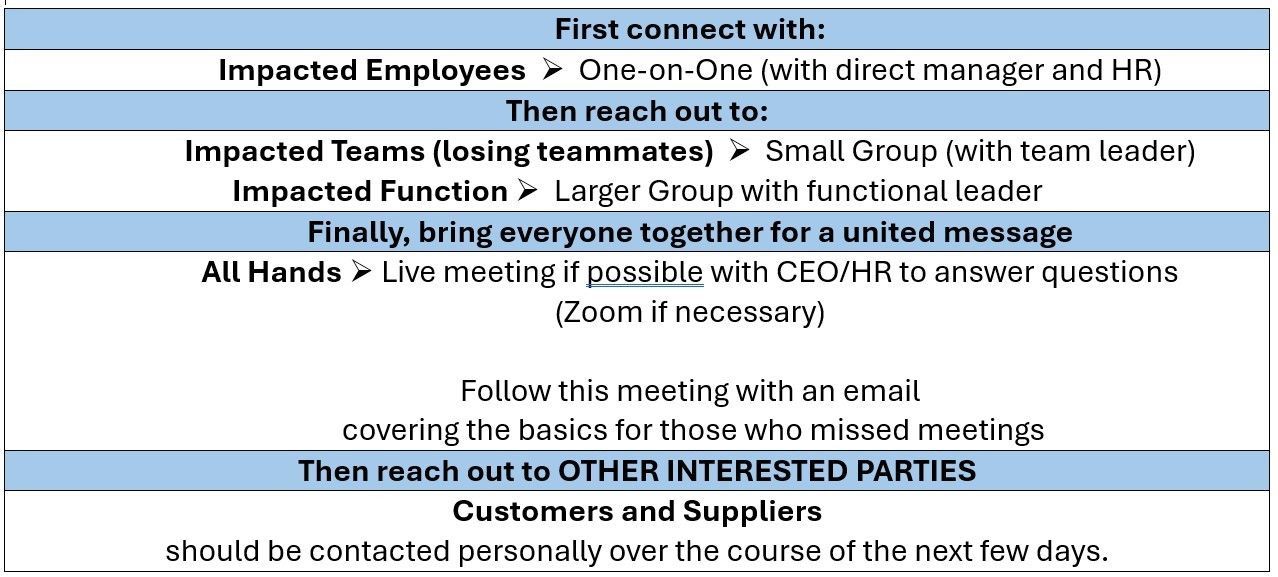
You will want to let other stakeholders know of the organizational changes you are making once the impacted – and then the non-impacted – employees have been informed. Consider having the leader of the supply chain and sales teams reach out to major suppliers and customers, respectively, to let them know what has taken place. This might be a good time to introduce who will be their primary contact going forward. As with other groups, you will want a thoughtful FAQ document prepared, in anticipation of the tough questions that suppliers/customer may have.

When it comes to Communications, Form follows Function
Ask yourself first what you hope to achieve with each of your communications to every audience – and let the answer to this one question drive how, when, and in what order you plan to communicate the unhappy news. As a general rule, the harder the emotional impact of the news, the more intimate the setting should be when conveyed.
Your role as a leader
As the leader of an organization going through this difficult time, all eyes will be on you. Your role is to put your own defensiveness aside and lean into being vulnerable and human, and showing you care about the very real concerns that each of these constituencies is feeling. Put aside your excuses, your anxiety, your desire to move on and push past this horrible experience. In the end, the buck stops with you – and you must own this moment with both humility and humanity.
If you navigate this change successfully, demonstrating that you empathize and can appreciate their pain and concerns, your team – while sad -- will remain committed as you come through the other side of this difficult moment. If you fail to show your empathy and humanity in this most critical of all moments that matter™, it may take months or years before your teams’ commitment, cohesion and performance recover.
# # # # #
As I’ve said before, I believe we all benefit in our business journeys by sharing stories of overcoming hard things.
What mistakes have you seen leaders make when announcing a layoff at their organization? What might you do differently next time you’re involved in communicating a workforce reduction at your company?